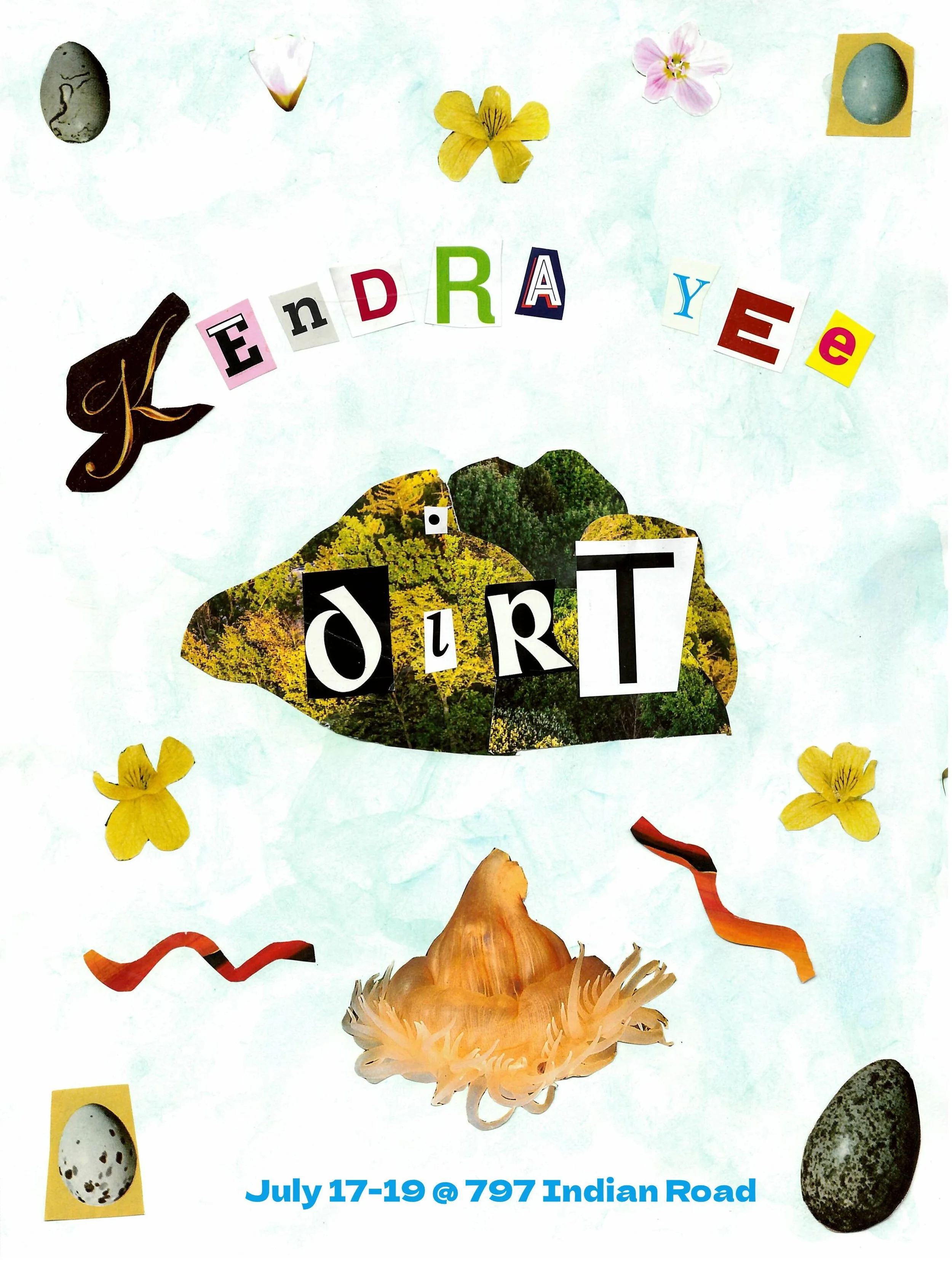
𝖉𝖎𝖗𝖙 presents textile work and pit-fired ceramics by Kendra Yee. Continuing Yee’s experimental artistic practice, 𝖉𝖎𝖗𝖙 forms a body of work that explores the intimate alchemy of working with found materials gathered from the local community where she lives and works. In 𝖉𝖎𝖗𝖙, “the environment” is not a backdrop for human experiences, but the very material in which living and nonliving lives unfold.
“dirt” by Kendra Yee
July 24-26 at host
Wednesday, July 15, 2026 in Toronto, Ontario.
This was the day that we planned on installing Kendra Yee’s work. If you were in the city, you also probably woke up to a sepia world tinged by a peppery smell and the bitter taste of smoke from distant wildfires. I had planned to walk a few dogs before hanging Yee's flag from my balcony. Instead, the smoke made the simple act of being outdoors feel precarious.
It was under these conditions that I began living with the works in dirt. I thought back to my first studio visit with Yee, where she introduced me to Till alongside a series of pit-fired clay. Both emerged from her ongoing practice of gathering found materials, such as soil from the local places where she lives and works, to add into her glazes and clay bodies. Born from the outside, these works carry the histories of their environment. On that orange-smokey day, the memory of the soil, air, fire, plant life elements that form these works felt at once profoundly fragile.
The title dirt gestures toward the relationship between material, place, and play that runs throughout Yee's experimental practice. Although often used interchangeably, dirt and soil are distinct materials; dirt is defined by what soil is not. Unlike soil, which sustains life, dirt is what remains: loose fragments of soil made of bits of pieces of rocks that cannot support plant life. The word also carries other meanings such as gossip, scandal, something unclean, and any type of soil found on the ground. In this outdoor exhibition, dirt is not only the ground from which her clay forms emerge, but also the stories, conversations, and quiet exchanges that accumulate within a community. Through both material and social residue, Yee transforms what is often overlooked into personal fictions and connections.
In Till, Yee stitches together a vibrant grid of fabric tiles dyed with solar dye and impressions from foraged flora, forming what she calls a “flag.” Imprinted with cloud-like patterns, floral textures, and irregular markings, the textile bears the traces of the landscape from which it emerged, and now it reflects flying over the garden. Bright illustrations of swirling organic forms, floral configurations, bursting spirals, radiant suns, and infinite galaxies punctuate its surface, hinting at an unseen enchantment embedded in the everyday environment, perhaps only visible to Yee and those who have learned to look closely.
Created in 2022 for St.Anne’s Anglican Church following an invitation from the art collective NetherMind to reflect on themes of ecological grief, Till is rooted in the memory of Yee's maternal grandfather, who tended an allotment in the United Kingdom. Through gardening and growing his own food, he cultivated a modest yet intimate relationship with the land, which is a way of living that has become increasingly uncommon in an era shaped by supermarket conglomerates and industrial food systems. Each textile tile is devoted to a particular plant, together forming a gridded landscape reminiscent of an allotment, where individual plots exist in relation to a larger ecology. Similarly, each grid represents an individual in relation to the greater community around them. At the same time, the repeating grid evokes the geometric systems humans impose over the organic topography of the land. Such structures sustain cultivation while often disrupting the organic topographies and ecologies they inhabit.
Suspended above our heads on the balcony, the two textile pieces that make up Till are domineering; yet against the sky, they become inconsequential. They do not signal a nation-state nor a family crest marking territory across a battlefield. Instead, Yee describes them as “a flag of surrender.” Yet, Yee’s flags of surrender do not fall into ecological clichés defined by climate collapse, disaster, or catastrophe. Rather, Till demonstrates that human life cycle remains inseparable from the environment through shared matter and the continual exchange of atoms that sustains all lifeforms.
Two years after Yee showed Till at St. Anne’s, the church was devastated by a fire that destroyed irreplaceable paintings, mosaics, and its Byzantine Revival architecture. In retrospect, fire became an unforeseen element to the work that brought it to the present. Alongside the wildfires that currently ravage hundreds of communities in Northern Ontario and smoke that drifted across Toronto while dirt is on, which prompted its postponement, fire creeps through this exhibition as a presence and turbulence. Underlying the narrative of this show is an unexpected, ever-present reminder that fire is both life-destroying inferno and a force of transformation. In Greek mythology, Prometheus’s stolen gift of fire began the life force in which humanity was born out of. Holding destruction and production, the works in dirt illuminate that the same element capable of engulfing the world can also become the condition for making another.
Scattered discreetly throughout the garden, Yee's pit-fired clay works await discovery. Nestled into wooden fences, window ledges, tree trunks, abandoned bee house, forgotten lamps, and unruly corners of the garden, they reveal themselves through moments of unexpected encounter. These framed ceramic and figures were created during a residency at Medalta in Alberta in a workshop led by Shary Boyle, where Yee experimented with pit firing—one of the earliest ceramic techniques. Dating back nearly 30,000 years, pit firing involves placing clay objects into a shallow pit in the earth before firing them directly. The open flames allow for smoke to dance across the surface, using the elements of earth, air, fire, and the passage of time to colour directly into clay. While the process allows unpredictable, atmospheric veils of smoke on the clay surface, it also simultaneously records microclimates during the firing. As a result, Yee’s clay bodies are a record of active collaboration with the elements and chance encounters. Like the phoenix of another myth, the clay emerges transformed by fire, a process in which destruction and creation are in harmony.
During the residency, Yee amassed soil, broken ceramic, and worked with simple forms cut from cookie cutters she has collected over the years to make the framed pieces. Their familiar silhouettes, unglazed grey surfaces, and earth-stained textures speak to the humility of a technique that has remained unchanged across millennia. Within these crisp contours, Yee brings together two practices she has increasingly developed in recent years—ceramics and illustration—and returns to their elemental origins. Their simplicity recalls the tactile pleasures of childhood, when learning often began through play and the manipulation of ordinary materials, including what can be gathered from outside. In returning to these foundational forms, dirt suggests that new ways of imagining the future may begin by rediscovering our oldest relationships with the earth.
Formed from materials we might otherwise overlook and sustained by stories that quietly circulate through everyday life, Yee's works ask us to keep witnessing despite the uncertainty that defines our geological moment. They invite us to attend to the glimmers of invisible lives that offer company, wonderment, and joy amid ecological grief. Faced with the immense losses from this past week, how do we honour and transform what we have all collectively experienced? dirt reminds us that what we need to transform the ordinary and begin again is all here.
Exhibition text by Ramolen Laruan
Artwork list
Till, fabric, mixed-media, metal hardware, 55 x 128 inches, 2022
Commissioned for the exhibition “Elegy” curated by NetherMind at St. Anne’s Anglican Church
Charming, pit-fire ceramic, wood frame, 6 ½ x 6 ¾ inches, 2025
Of a figure, pit-fire ceramic, wood frame, 4 ¾ x 9 ¾ inches, 2025
Mama with kids, pit-fire ceramic, wood frame, 6 x 6 inches, 2025
Bite, pit-fire ceramic, wood frame, 7 x 4 inches, 2025
Starling, pit-fire ceramic, wood frame, 8 ¾ x 5 ½ inches, 2025
Crest, soda fire ceramic, 2025
Kiki (series), soda fire ceramic, 2025
Frolicking with friends, soda fire ceramic, 2025
1000 years old, raku fire ceramic, 2025
Kiki in the Garden, soda fire ceramic, 2025
jolly, soda fire ceramic, 2025
shadow boxing, soda fire ceramic, 2025
An Interview with Kendra Yee by Ramolen Laruan
RL: You’re mostly known as ceramic artists. What prompted you to work with ceramic?
KY: When I was kid, my parents used to take me to the Gardiner Museum for their “drop-in” clay classes. My parents are not very sentimental, yet they’ve kept these small childhood sculptures. I was obsessed with creating animals.
Clay was always very present on top of the working two-dimensional like drawing. But it was really when I went to OCAD in third year that I took a Surface Design Course where I learned that being in the ceramic studios mean I had access to a studio. In the ceramic studio, you could properly spread out. The medium forces you to be present within a space and a working environment, and to collaborate with others within the space. That was the first time where I also learned the value of a studio space and how wonderful it was creating alongside your peer group.
Being able to play with something brought me a lot of joy. Working with clay and making weird shapes and documenting your movements, patterns, and imprints were experiences of learning through play. This was present within the studio space.
RL: Play is such a great word for the methodology in how you create. Each of your ceramic is so playful and each has their own personalities, quirks, feelings, and backstories. Do you have a plotline or story in your head when creating each one?
KY: When working with ceramics, I always thought that my illustrations were going to influence ceramics more, but ceramics really influenced the way that I handle drawing now. So the way that I create drawings now, it feels like it's shaping with ink, the papers, and really considering the use of positive space and how much information you can kind of put onto the page without there being the addition of a line or shape. I'll often create these drawings that are world building within themselves, then take those drawings into the sculptures.
RL: The process of making ceramic hasn’t really changed. This might sound crude, but why still work with ceramic?
KY: There is so much play involved in the medium. It goes through so much stress and really intense environments. There is a life cycle to clay. This is something that I'm continuously curious about and there's so much. It feels really nice to have gaps in your knowledge of creating because that creates senses of curiosity, playfulness, and frustration, too. Because it has an inherent intensity of different emotions that become very addictive to play around with.
RL: The works you’re showing are made with different materials. Yet with the textile and ceramic, I see many links, one is the playfulness with the materials. Can you talk about how your work with ceramic speaks in your other different mediums that you do.
KY: Learning and like trying something new excites me—the process and rush of emotions from it.
RL: I think that's what's so exciting about artists. Artists are always trying to learn something new to get to whatever they’re trying to do. You're always trying to figure out something to get to whatever you want because you realize that whatever you’ve learned is not enough.
KY: Unlearning is important too. Try to make mistakes. Ceramic teaches me humility. You just never know what's going to happen with it and you have to be open to the process. As a ceramicist, you're trying to control the environment to the best of your abilities. Both chemistry and alchemy.
RL: There’s a magical spiritual element in your work. Even calling it alchemy just now. And on your website, it says, your objects “bring prosperity and luck”. Can you talk about that?
KY: Magic is important to me. Being able to hold on to magic in the everyday creates elements of surprise. You’re engaged and present. There's so much possibility and wonder, but it can also be dark magic too. There’s this constant energy out in this world and it’s important to witness these moments.
RL: What kind of moments?
KY: Like when you're working. With my charms and pendants, I told people to place these pieces in elements of their house where they only know. When you move through different spaces with these trinkets and charms, they become moments that you can witness.
I talk about how banter is really important. I always say that people in Toronto don't know how to start a conversation, but as soon as you get them into a conversation, they actually have a lot to say. Openness versus closeness. Being open is like magic. It’s also important to be closed sometimes to protect yourself from all these elements. I get more energy and engagement when I can have these moments of magic or moments of banter through interactions with strangers or strange items that you see on the street.
RL: Having these figures is a very personal and intimate relationship. It’s like an inside joke.
KY: Yes, like an inside joke! The first Neolithic sculptures were figures. They're not quite human. They're not quite alien or animal based. They're like in between different spaces. When I'm making these works, I say that they're not complete until they enter somebody's home. I have these stories for these characters, but it is truly the stories that other people tell me about where the characters end up that I feel they are actually growing into themselves. This is the activation, the magic, you know?
RL: I was reading about this and they say that the first Neolithic sculptures might have been made by children… Which is so special because when we think of ceramic right now, we think of pots, funerary urns, something that's utilitarian and useful. And the craft has become even more elaborate and technical.
KY: It’s one of those things where it's meant for play and as you become an adult, you become separated from that. It’s funny.
Clay allows me to escape into imaginary play. Many people don't get to indulge in this; not even indulge, but just activate those moments of play. When I was like a kid, I was really nervous about going to school. In my bag, I would always carry one toy from home and my EpiPen. The charms are like my adult version of these toys. You get to carry something with you that is a reminder of comfort and home.
RL: Both “useful” “and not useful.”
KY: That's very me. Not necessarily “useful,” but I like tangible and practical things like an object and meaning-making. And if the object serves a function, it's imaginary.
I’m not making anything practical. Even if I make a bowl, it's still wonky. I do love thinking about questions of design and the functions. But flipping it where you're designing objects for the imagination.
I would repeat the same form over and over again. It slowly evolved and brought me back to [primary] fragments. There are these universal shapes that cross broad cultures. For example, think of an object that holds water. What are the infinite ways it can hold the water?
RL: You speak about how clay takes many forms and how you like to forage your materials. Yet in your final pieces, this foraging aspect is almost hidden. Your work looks new. I know this is cliché, but your characters are very original.
KY: I have a lot of archetypes within my work, specifically little imps and devils, these mischievous figurines. These were a lot of the pieces that showed up in the Patel Brown show a couple years ago. Collecting all these different actors into the space and having them engage looks new but they've been in repetition for some periods of time. They might even refer back to a drawing, which will refer back to another sculpture…
RL: You reuse a lot of your stuff. Is it important for the audience to know where these come from or the process in which you build or form?
KY: Secrets that were hidden are revealed through conversation. I wait for others to present the invitation to view their world building. If a person is drawn to a certain character, I ask questions to understand what they see in the figure. Sometimes, I threaten that these stories that are shared will be used for future pieces.
RL: You’re not closing up your work to what you mean it to be. And I think that you want others to take it home and also imbue meaning.
KY: Building the home, observing the house.
RL: I’m interested in the material handling of your work. You mentioned making a pot that doesn't work or a pot that's wonky. There’s imperfect pinching, kneading and finger marks—very different from how ceramic is usually perfectly formed. It has that playful element where you are going against this technical virtuoso of like what it means to be like someone who's a master of their craft. But it is highly technical. Your work is highly technical. It shows in many different ways. Can you talk about how you play with these expectations?
KY: I love the texture. I love really seeing somebody made. The pinching and pulling of something. The ways that—at least when I'm viewing a sculpture—somebody potentially moved while building it. Those elements come back into my work. I also love the ways that people have to view sculptures. It’s similar to the motion of building the work where you have to circle something. You have to pull away from it, go up close to it.
RL: You're figuring out how they made it.
KY: It’s the best game when you're in a ceramic-based exhibition to be able to work through the steps in your head. Or thinking, how would I work through this?
RL: You're more interested in what’s happening in that moment, catching what happening in the room. Which, again, is connected to how ceramic is seen in an archeological and museum context as something that keeps secrets, as a vessel of memory. But you're very specific. And you know, they didn’t really care about that, right? Those who made those ceramics thousands of years ago didn't know that we would dig them up to try to understand their worlds.
KY: Secrets are important. They’re allowed to come and go. I think everybody loves a secret, whether they want to admit it or not. It’s about choosing when they live and choosing when they pass.
RL: Can you speak about how you talk about your work as personal fiction? What does that mean to you?
KY: I think, and this goes back into the elements of both taking real stories from other people and real experiences from yourself and twisting up all those experiences. The more you remember a memory, the more it kind of takes on a life of its own and it's never inherently where it was to begin with. Through these twists and motions, and the addition of time and other experiences, it never exists in its original form. The beauty of letting that go and understanding that memory cycles through into something else. In order to create a memory, you have to let another memory go.
RL: Secrets…
KY: And gossip and banter. Personal fiction is my way of engaging with the community. That is the most influential when it comes to the works I create and the things that I discover within myself, my art practice and the ways that new friendships and new relationships are born through those experiences. Tangible experiences build you into a person and are filtered through self-perceptions. There’s always a bit of fiction.
RL: This is maybe a bit more personal, but, uh, you sound really spiritual…
KY: I've gotten that before. I grew up with instances of religion. I've also had strangers tell me, “This is not your first time here.”
There is a lot of myth-building in both my Chinese and Scottish heritage. If I grew up around it more, I could feel more connected to something… As an artist, I get to do so much meaning-making though! I’m not really concerned about why I’m here, you know?
RL: I think it's more your love for animals that you’re more interested in, if you know what I’m saying.
KY: Yes, I’m more interested in connectivity rather than, um, a sense of purpose…
RL: In alchemy and science. You just love making and doing.
KY: I want to do it all. If I could [work in all mediums], I would.